Braz. political sci. rev.2026;20(2):e0005.
Exploring the Heterogeneity of Brazilian Municipalities: continuous differences of discrete types?
Ursula Peres
 , Eduardo Marques
, Gabriela Armani
, Eduardo Marques
, Gabriela Armani
DOI: 10.1590/1981-3821202600020005
Abstract
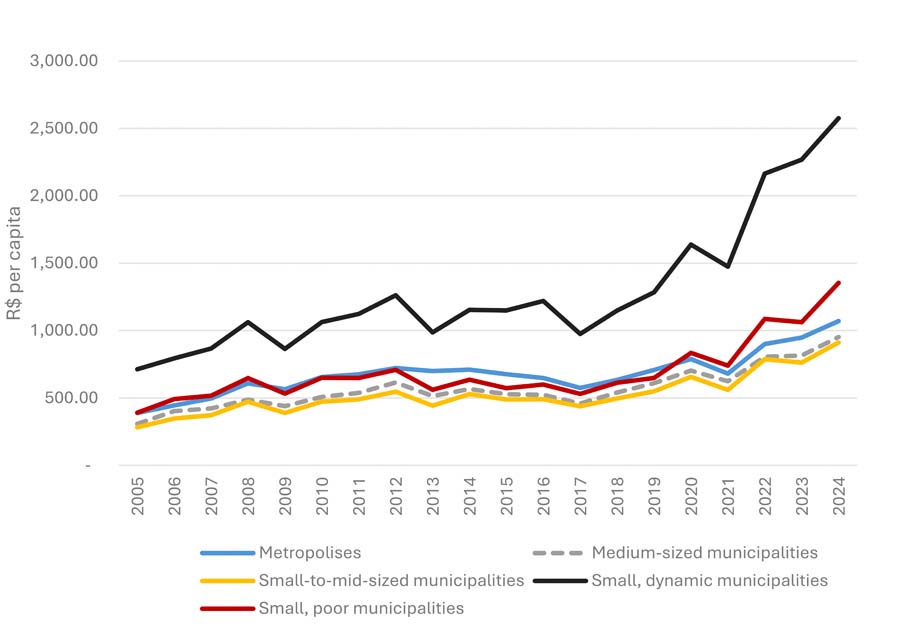
Brazilian municipalities simultaneously function as local administrative units, service providers, electoral districts, and the primary units for aggregating statistical, fiscal, and demographic data. Although their heterogeneity is widely acknowledged, the underlying structure of this heterogeneity is rarely examined. In this article, we argue that this heterogeneity should be understood as discrete, rather than as continuous variations of a single territorial form, and we propose a typology to explore these differences. The typology is derived from cluster analysis of Brazilian municipalities and allows us to examine differences across these units using panel data on fiscal, demographic, and political variables from 2005 to 2024. The results identify five distinct groups of municipalities. A large majority consists of very small and poor municipalities characterized by low levels of urbanization, dependence on intergovernmental transfers, limited local state capacity, and a right-leaning political landscape. The remaining groups differ in terms of scale, urbanization, economic structure, administrative capacity, political dynamics, and revenue and expenditure patterns. This analysis suggests that Brazilian municipalities constitute intrinsically different types of units, especially in fiscal terms, raising methodological concerns about their generic use as a unit of analysis in studies of public policy, local government, federalism, and fiscal issues.
Keywords: municipalities; public policies; social policy; urban policy
231