Braz. political sci. rev.2024;19(1):e0006.
Is the Public Sphere Still Alive? Longitudinal Analysis of Climate Change Issue Attention Across Newspapers and Social Media Platforms (2014-2022)
Diógenes Lycarião
 , Marcelo Alves dos Santos Júnior
, Cláudia Regina Ferreira
, Kaique Mancoso
, Marcelo Alves dos Santos Júnior
, Cláudia Regina Ferreira
, Kaique Mancoso
DOI: 10.1590/1981-3821202500010006
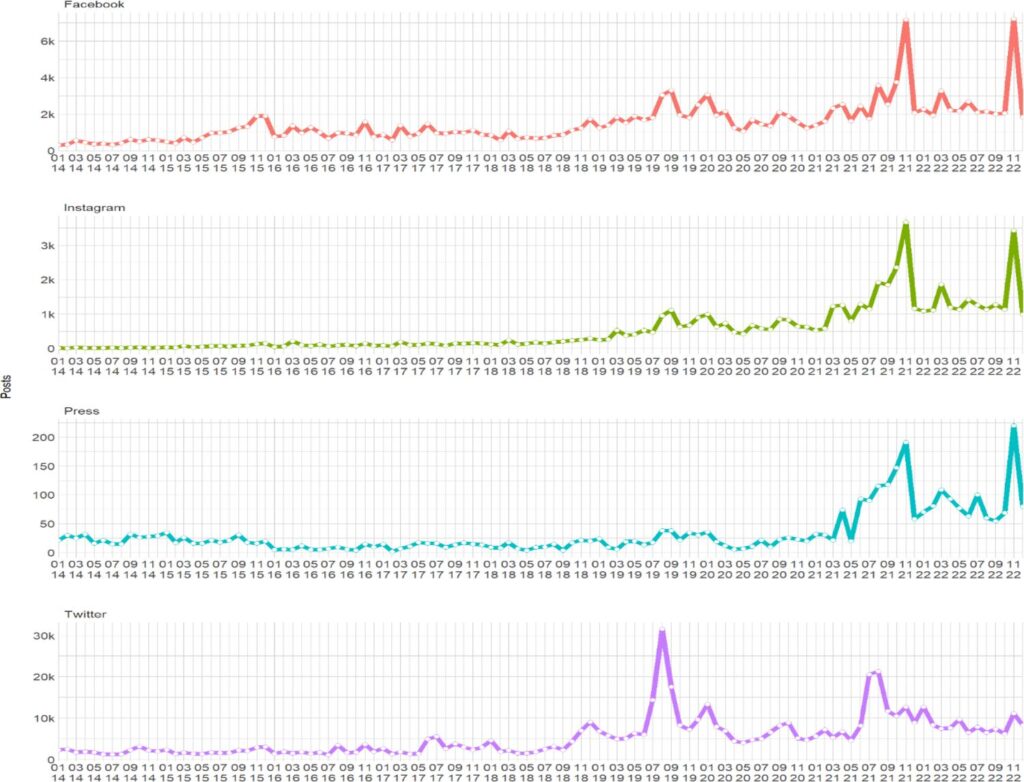
A growing body of literature suggests that the platformization of the public sphere is eroding the public debate, thus potentially leading to the fragmentation of the public sphere. While there exists mounting evidences supporting this perspective there also exists a substantial body of literature that suggests otherwise. Within this realm of mixed evidence, studies on climate change visibility play a prominent role, presenting findings that both weaken and reinforce the fragmentation hypothesis. To investigate this matter in a context conducive for a fragmented public sphere, we collected a longitudinal (2014-2022) and cross-platform (Instagram, Facebook and Twitter) dataset (n=794.281) and correlated it with a secondary database on the press coverage of climate change in Brazil (n=3.490). Our analysis reveals a robust positive correlation between these datasets, indicating that the Brazilian public sphere retains the capacity to interconnect various arenas of visibility. We argue that this finding is particularly significant, given that it emanates from a case characterized by circumstances favoring a high degree of public sphere fragmentation. Consequently, our discovery lends support to a less pessimistic assessment of the influence of platformization on political communication within the deliberative system.
Keywords: climate change; deliberative system; fragmentation; news media; Platformization
267