Braz. political sci. rev.2026;20(3):e0006.
Institutionalization Trajectories of Cash Transfer Programs in Brazil: Renda Mínima, Bolsa Família, and Cartão Família Carioca
Erica Aparhyan Stella
 , Marcela Garcia Corrêa
DOI: 10.1590/1981-3821202600030006
Abstract
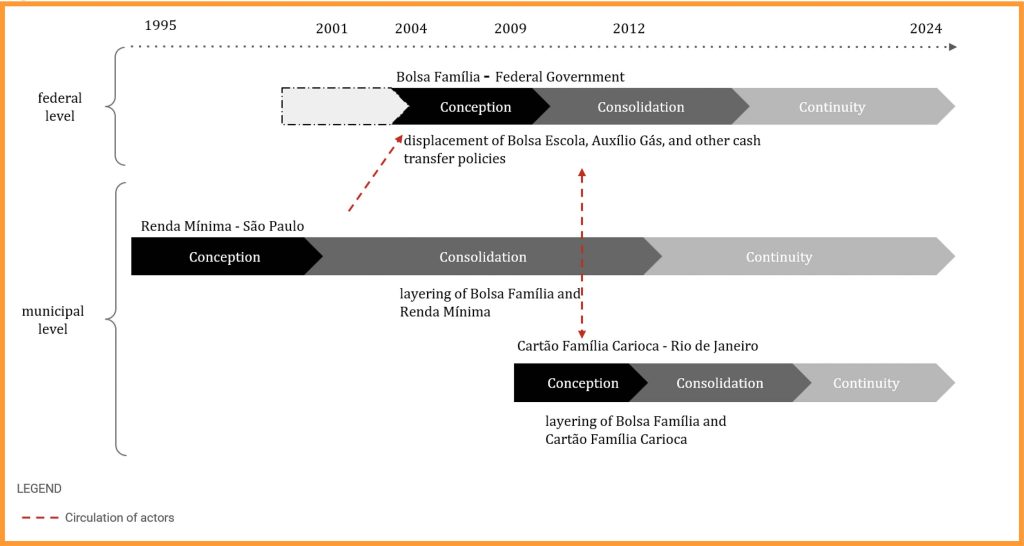
The article examines how municipal policy implementation arrangements, developed across different periods and contexts, interact with national policies within multilevel governance dynamics. To do so, it examines the institutionalization trajectories of three cash transfer programs in Brazil: Renda Mínima (SP, 1998), Cartão Família Carioca (RJ, 2010), and Bolsa Família (National, 2004). The study highlights the importance of theoretical debates, the circulation of actors across different levels of government and institutions, and the role of policy designs and instruments in shaping the formulation and implementation of these initiatives. The study examines how different scales intersect with the temporal dimension in shaping long-term trajectories. Renda Mínima contributed to the formulation of Bolsa Família by serving as a space for policy experimentation, while Cartão Família Carioca emerged within an institutional context already consolidated through earlier experiences. Based on a qualitative and comparative approach combining data triangulation, document analysis, and a review of the specialized literature, the article concludes that analyzing multilevel dynamics over time is essential to understanding processes of institutional change and the consolidation of public policies. Thus, the study underscores the importance of interactions across different levels of government and historical contexts in shaping public policies.
6